
Rethinking the Operating Model: A Design-Led Approach from the Inside Out

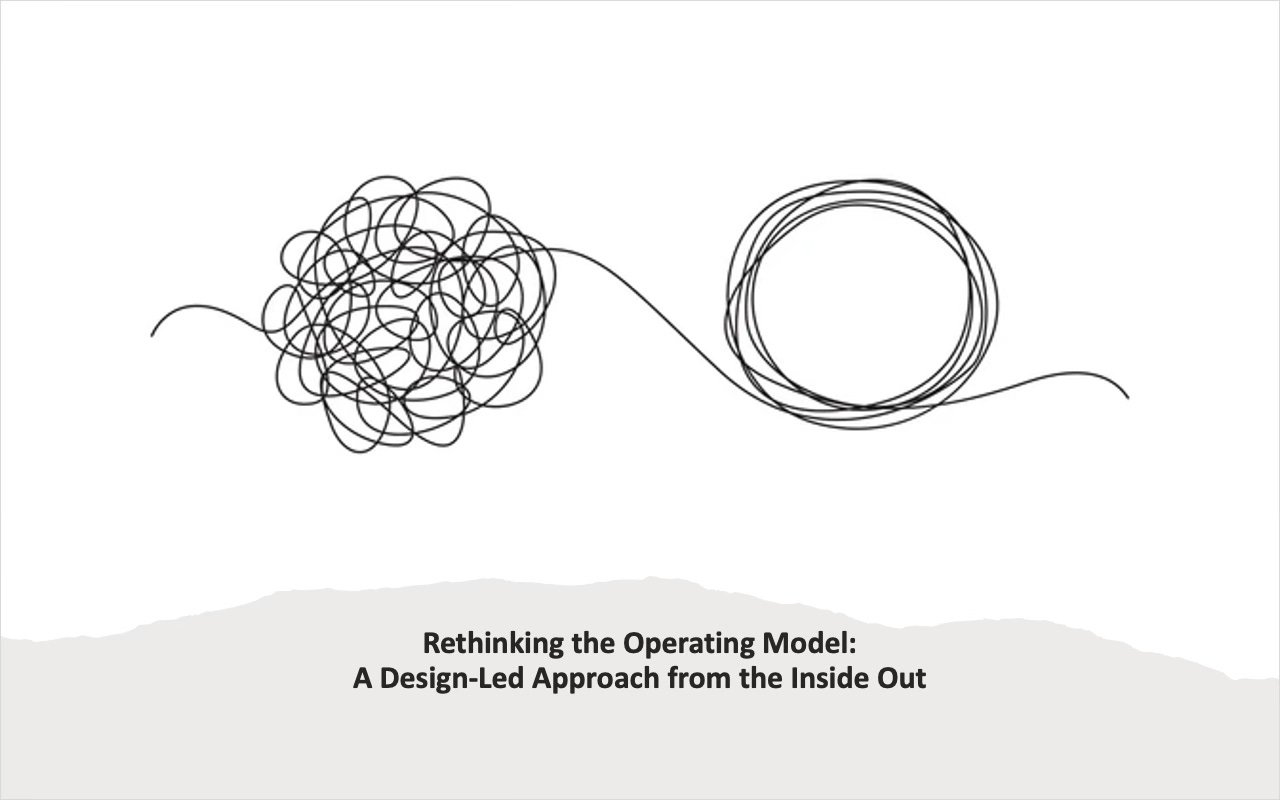
Many organisations invest heavily in new operating models — Agile, product-led, customer-centric. All seek to solve the same problem: how to become faster, more adaptive, and closer to the customer. And yet, 12–24 months in, a familiar pattern begins to emerge.
Some things improve, but many of the underlying challenges remain. Clarity is still lacking. Decision-making can feel slow or inconsistent. Teams find themselves working around the system rather than through it.
So, the question becomes: how do you evolve an operating model once it’s already in place?
We were recently engaged by the Australia and New Zealand division of a global organisation facing this exact challenge.
Eighteen months earlier, they had implemented a new Agile operating model. The intent was clear: improve responsiveness, strengthen customer connection, and unlock greater innovation across the organisation.
However, like many organisations operating outside of pure tech environments, the reality was more nuanced. This was not a world of fortnightly releases, but a highly regulated, matrixed environment with competing priorities, multiple stakeholders, and deeply embedded ways of working.
They didn’t need another training program, nor did they need a new framework. What they needed was a clearer understanding of what was actually working, what was getting in the way, and how to evolve the model in a way that would genuinely stick.
Start from the inside, not the model
One of the most common mistakes in operating model reviews is starting with the model itself — focusing on processes, structures, and governance.
Instead, we took a different approach, one more commonly applied in customer innovation but less often used internally. In partnership with the internal team, we started with the people living inside the system.
Through a series of structured conversations across roles and teams, we explored where people felt confident and where they hesitated, where work was flowing and where it was getting stuck, and where the model was enabling progress versus creating friction.
What emerged was not a failure of Agile per se, but a set of very human, very practical challenges. There was a lack of clarity around roles and decision boundaries, fragmented communication across teams, and misaligned priorities and trade-offs. Many people felt they had limited capacity to step back, learn, and improve, while others noted a growing drift away from the customer.
In other words, the model itself wasn’t broken. However, the experience of working within it needed attention.
Designing with the organisation, not for it
The second shift in approach was equally important.
Rather than stepping away to diagnose and prescribe, we worked alongside a cross-functional internal squad to co-design improvements. Operating models don’t change through documents alone; they change through shared understanding, ownership, and behaviour.
Together, we translated insights into clear opportunity areas and brought teams into the process of reimagining how the model could work better within their context and constraints.
This involved generating and shaping new ways of working, prototyping practical changes to roles, rhythms, and interactions, and testing these ideas with people and leaders across the organisation for desirability, feasibility, and early viability.
Not all of the ideas were revolutionary. In fact, many were necessarily practical. But they were grounded in real needs, tested early, and owned by the people who would ultimately make them work.
From model design to model experience
There is a broader lesson here for leaders.
Operating models are often treated as structural design challenges. In practice, however, they are just as much experience challenges.
When people lack clarity, they hesitate. When decision rights are unclear, work slows down. When priorities are misaligned, capacity becomes diluted. And when teams are disconnected, collaboration breaks down.
No amount of process and structural design alone can resolve these issues.
What does make a difference is stepping back and asking whether people truly understand how the model is meant to work, whether they feel confident operating within it, and whether it genuinely enables them to deliver value — both for customers and for the organisation.
A different way to evolve
For this organisation, the output was not simply a set of recommendations, but a set of validated, prioritised concepts that are now feeding directly into their implementation roadmap. More importantly, the process created a shared understanding of what needed to change, and why. And that is the real shift.
Because evolving an operating model is rarely about starting again. It is about making it work in reality, not just in theory.
If you are 12–24 months into a new operating model and seeing mixed results, the answer may not be more training or another redesign. It may be to step inside the system and evolve it from the perspective of the people experiencing it every day.
And if this sparked some ideas, feel free to like or restack so so others can take a fresh look at how their operating model is working in practice.
Happy innovating,
Nathan
I am the founder of customer-driven innovation and growth firm Methodry (Method•ry) and author of Innovator’s Playbook, published by Wiley. I help teams build their innovation mastery and work alongside them to innovate on their most important challenges.